
The Modern Appeal: Why Arabescato Grigio Looks Contemporary, Not Classic
Arabescato Grigio marble sits in a sweet spot that modern interiors keep chasing: it is expressive, but not loud. The grey background reads neutral under a wide range of lighting temperatures, while the veining adds just enough movement to keep minimalist rooms from feeling flat. In a world of matte paints, warm woods, and black metal trims, Arabescato Grigio behaves like an architectural texture rather than a decorative pattern.
Another reason it fits modern design language is scale. Contemporary interiors prefer fewer breaks, fewer grout lines, and larger visual planes. Arabescato Grigio rewards that approach. Used as large-format slabs or carefully aligned tiles, it creates a continuous “calm drama” effect that feels curated rather than busy.
Material Truths: What Arabescato Grigio Is Physically
Arabescato Grigio is a marble, and marble is primarily calcite-based. That matters because calcite is chemically reactive to acids. In practice, this means Arabescato Grigio can etch when exposed to acidic liquids and harsh cleaners, even when it is properly sealed. This is not a defect; it is a predictable material behavior that must be designed around, especially in kitchens and wet zones.
From a performance perspective, typical published reference values for Arabescato/Grigio-family marble show a density around 2705 kg/m³, water absorption around 0.12%, and flexural strength around 12.1 MPa. A separate technical data sheet for Arabescato reports water absorption around 0.11% and flexural strength around 17.8 ± 2.9 MPa, illustrating that you should expect a range depending on quarry source and batch.
These numbers are not only for engineers. Designers can use them to make better placement decisions. Lower water absorption generally improves stain resistance when sealing and maintenance are done correctly. Flexural strength matters for thin edges, large spans, and wall cladding panels. Density affects transport, handling, anchoring, and substrate requirements.
Key Parameters You Should Ask Your Supplier to Provide
A Practical Technical Snapshot
The table below translates technical properties into interior decisions. Values are representative references; your project should rely on batch-specific test reports when possible.
| Property | Reference Range | Why it matters in interiors |
|---|---|---|
| Apparent density | ~2705–2710 kg/m³ | Heavy slabs influence handling, wall loads, and anchoring strategy |
| Water absorption | ~0.11–0.12% | Lower absorption supports better stain control when sealed properly |
| Flexural strength | ~12–18 MPa | Critical for thin details, large panels, and long countertop spans |
| Mohs hardness | around 3 (typical for marble) | Marble scratches more easily than many siliceous stones |
| Chemical sensitivity | high for acids on calcareous stones | Drives kitchen rules and cleaning product selection |
What Those Numbers Mean in a Real Room
A slab may be technically strong, but real interiors are “systems,” not lab tests. If a 30 mm countertop edge looks stunning but the base cabinets are not perfectly level, you can end up with stress points that lead to cracks over time. If a wall panel is mechanically anchored but the substrate moves, you may see micro-fractures around fastening locations. If a bathroom uses acidic descalers, the finish can dull even when the stone itself remains structurally sound.
Where Arabescato Grigio Works Best: High-Confidence Applications
Bathrooms: The Most Reliable Win When Finish and Cleaning Are Chosen Correctly
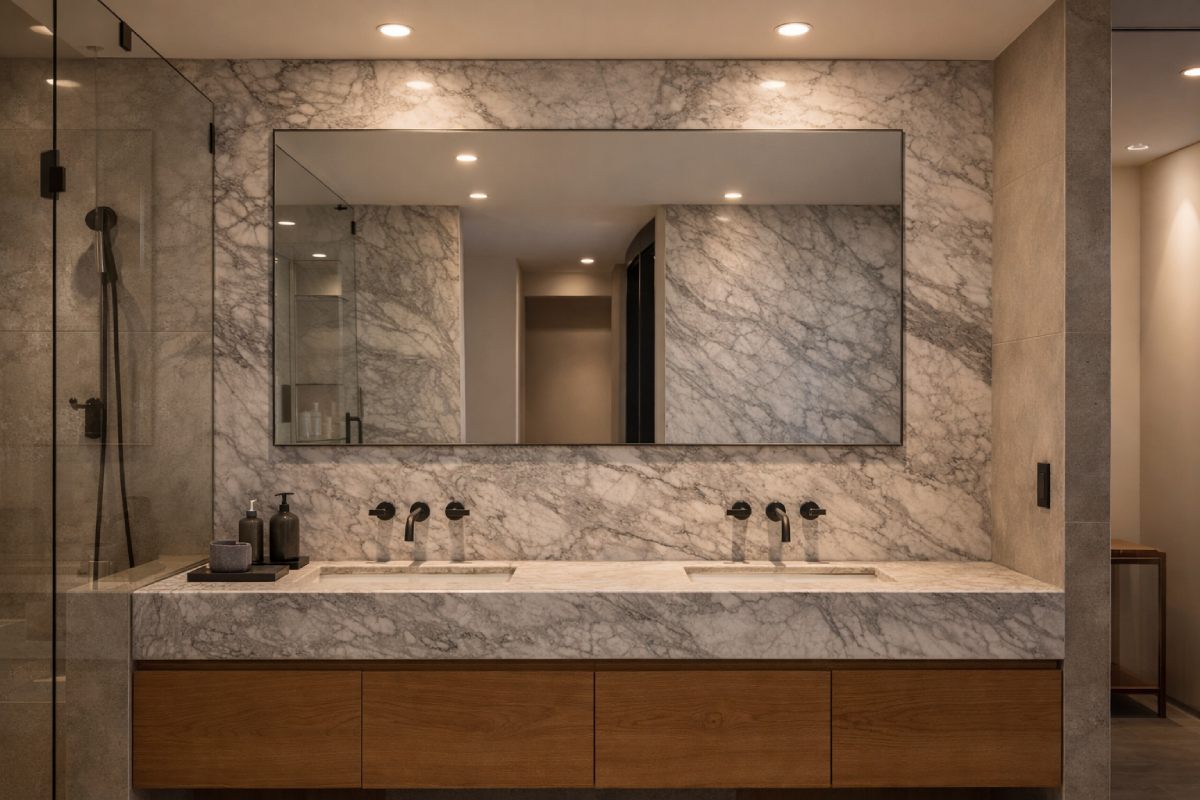
Bathrooms are where Arabescato Grigio can deliver maximum visual impact with manageable performance risk. The stone’s grey background supports a spa-like mood, and the veining adds depth without making the room visually heavy.
Best-fit bathroom placements
Honed wall slabs, vanity tops, full-height backsplashes, and niche surrounds are excellent. Large slabs reduce grout and make the room feel more architectural. In a 6–10 m² bathroom, a single full-height slab behind the mirror can read like a custom feature wall.
Real scenario: Boutique hotel durability logic
A boutique hotel renovates 20 guest bathrooms with the same visual goal: premium, calm, and consistent. The team specifies honed Arabescato Grigio for vanity tops and one vertical feature panel, but uses a tested, high-friction porcelain for shower floors. This split strategy keeps the signature stone in the highest-visibility zones while controlling slip and maintenance risk where water exposure is constant.
The failure mode to design around
Many cleaning products and bathroom habits are acid-driven: vinegar-based cleaners, descalers, citrus-scented sprays, and aggressive scouring powders. Industry care guidance warns that acidic products can dull or etch calcareous stones, and abrasives can scratch.This is why bathroom success is often less about stone selection and more about specifying the maintenance protocol as part of the design.
Living Rooms: Feature Walls That Feel Architectural, Not Decorative
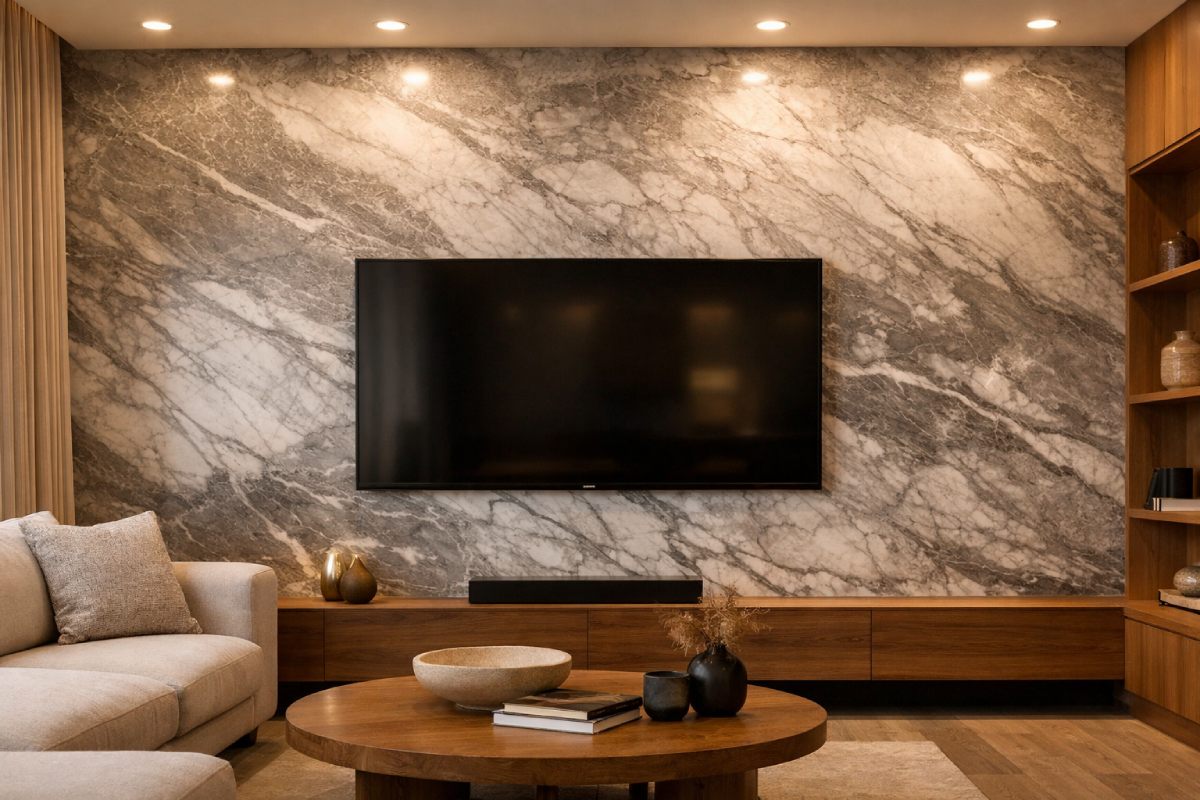
Arabescato Grigio is extremely strong for modern living room feature walls because it behaves like a textured plane. It adds movement, but it does not visually “shout” in the way highly contrasted stones can.
Best-fit living room placements
TV walls, fireplace surrounds, low-height wall cladding behind seating, and vertical accent panels. The stone pairs especially well with warm oak, walnut, and soft matte paint. With 2700–3000K lighting, the grey base looks warmer and the veining reads softer.
Vein planning: the modern difference-maker
A modern interior often fails when stone is installed like wallpaper. The smarter approach is to treat the veining as a composition. Bookmatching can look premium in symmetrical spaces with a centered focal point. Random matching can look more contemporary in asymmetrical layouts. This is not merely aesthetic; it also reduces waste because you can select a matching strategy that suits the available slab movement.
Fireplaces: A Controlled Statement with Modern Classic Energy
Arabescato Grigio works beautifully around fireplaces because it delivers “quiet drama.” The stone can frame the firebox without dominating the whole wall, which is ideal for modern classic and warm minimalism.
Performance notes for fireplace surrounds
Fireplace surrounds are usually wall cladding, not flooring, so the primary risks shift from slip to heat and installation system compatibility. When the project is commercial or highly engineered, it is common to align product selection with recognized natural stone standards for cladding and floors depending on the application type. EN 1469 specifies requirements for natural stone slabs used for cladding, and EN 12058 addresses slabs for floors and stairs, including technical changes and added requirements such as skid resistance and release of dangerous substances.
Kitchens: A Conditional Yes That Requires Expectation Management
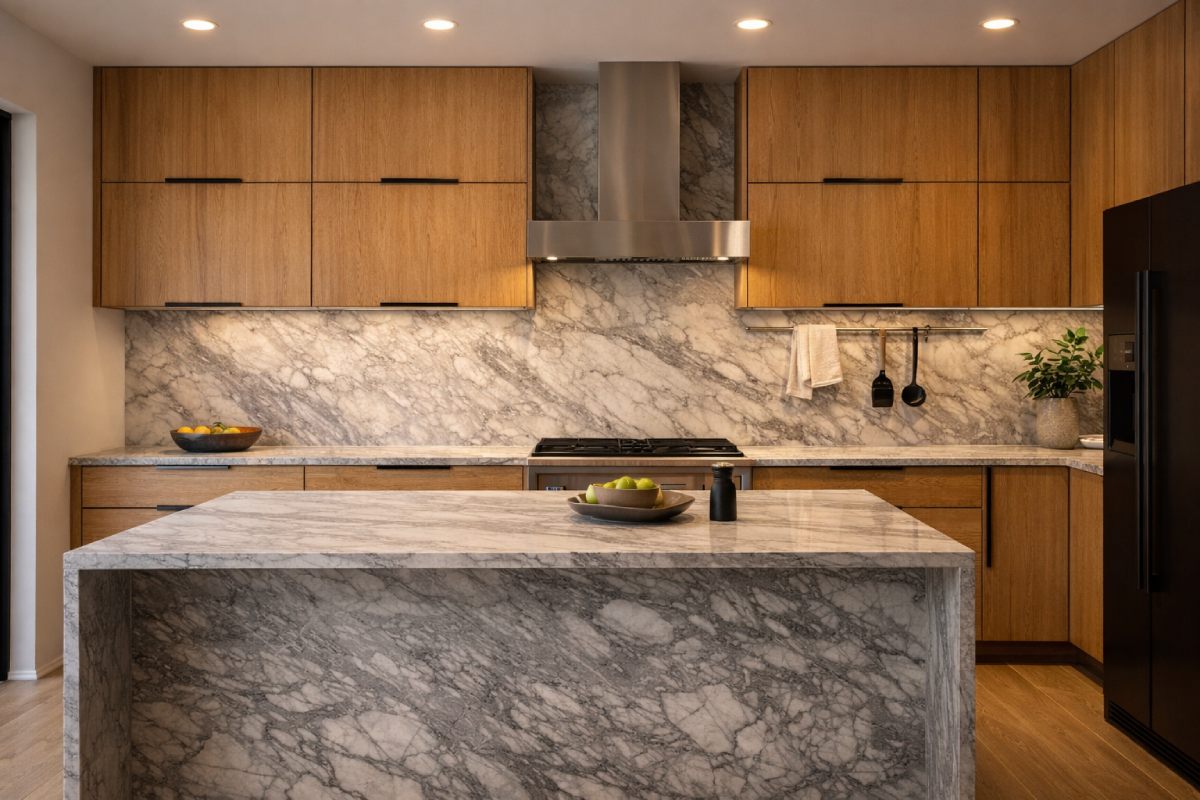
Arabescato Grigio in modern kitchens is one of the most photogenic choices you can make. It pairs with matte black fixtures, warm woods, and minimalist cabinetry better than many bright white marbles because it keeps contrast controlled.
Where it performs best in kitchens
Backsplashes, island cladding, and vertical splash panels behind sinks work very well. These are high-visibility zones but typically see less acidic dwell time than worktops.
Countertops: the honest trade-off
As a countertop, Arabescato Grigio demands a mindset shift. If your user expects a surface that never changes, marble is the wrong promise. Acid etching can occur quickly depending on liquid strength and dwell time. Sealing helps with staining, but it does not prevent etching because etching is a chemical reaction at the surface, not a stain penetrating the pores. Care guidance for natural stone explicitly warns that acidic products can dull or etch calcareous stones.
If the user accepts patina as part of luxury authenticity, then a honed finish can age gracefully. Many modern homeowners prefer honed precisely because it hides micro-wear and reduces “spotlighting” from reflections.
Floors and Stairs: Where the Spec Must Be Evidence-Based
Floors are the application where marble can go from “beautiful” to “problematic” fastest, especially in wet or high-traffic environments. Modern design has moved toward defensible safety decisions, and slip resistance is now frequently tied to standardized evaluation methods.
Slip resistance and the D value conversation
In North American specs, people often talk about DCOF, or dynamic coefficient of friction, as a measurable indicator for slip risk. ANSI A326.3 describes test methods for measuring DCOF of hard surface flooring materials and includes product use classifications and guidance for specifying flooring materials. Industry commentary on the updated standard commonly references category targets such as 0.42 for interior dry and interior wet, 0.50 for interior wet plus, and 0.55 for exterior wet and oils/greases contexts.
Marble is not ceramic tile, and finishes, sealers, wear, and contamination will change traction behavior over time. The modern approach is not to assume numbers; it is to test the actual finished surface under the applicable method and then match it to the real use scenario.
Europe and UK: EN 16165 context
EN 16165 is a standardized set of methods for evaluating slip resistance of pedestrian surfaces, with an effective date commonly listed as 03-Nov-2021.Even when a project is not in Europe, the fact that these standards exist reflects a broader global trend: safety and documentation are becoming as important as aesthetics, especially in hospitality and public spaces.
Where Arabescato Grigio flooring makes sense
Dry living rooms, low-traffic bedrooms, and controlled residential corridors can work well with honed finishes. Wet entry zones, bathrooms, and stair treads should be approached conservatively. For stairs, the cost of a slip event is high, and the design should prioritize traction strategy over visual continuity.
Finish Selection: Honed vs Polished and Why It Changes Performance
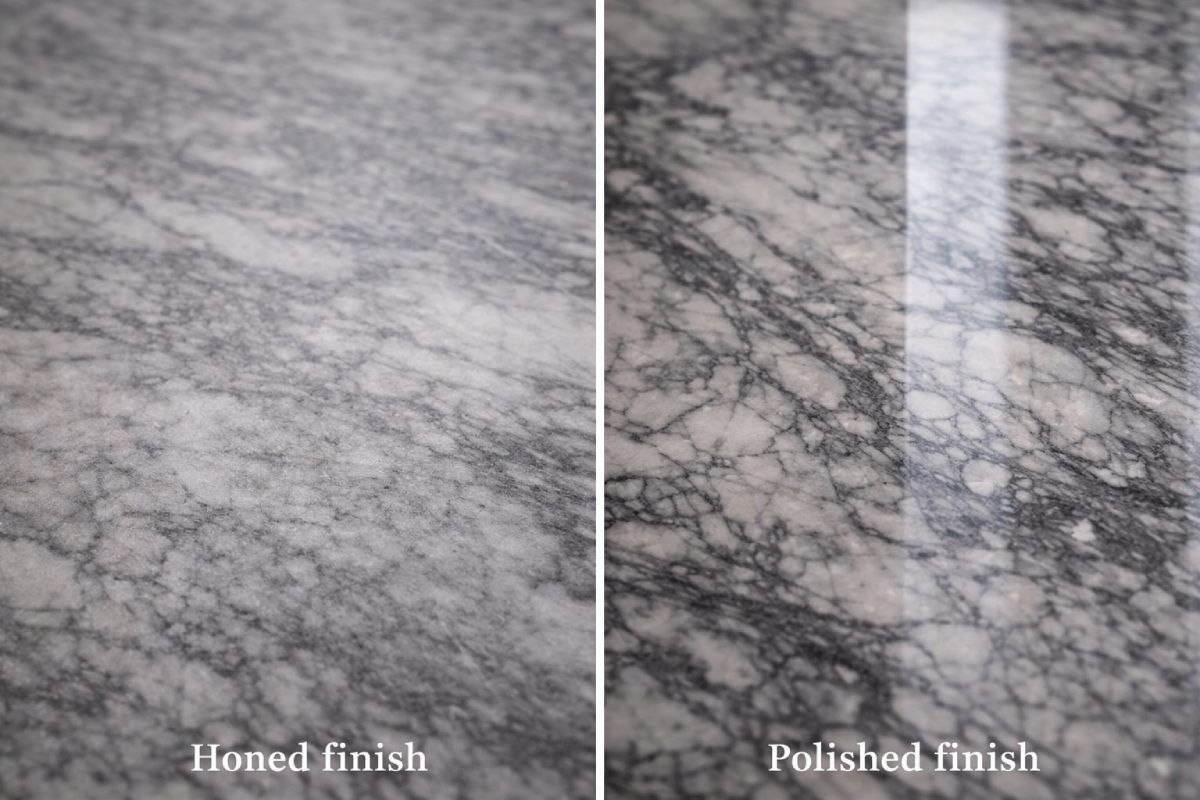
Finish is not a styling detail. It is a performance decision.
Honed finish: modern, forgiving, and stable-looking
Honed Arabescato Grigio reduces glare and hides micro-scratches better. In bathrooms and warm minimalism interiors, honed finishes feel more natural and less formal. They also reduce the “spotlight effect” where small surface changes become highly visible under directional lighting.
Polished finish: dramatic, reflective, and maintenance-sensitive
Polished marble can look spectacular in controlled environments like formal lobbies or low-contact feature walls. But in daily-use zones, polish makes water marks, cleaner residue, and micro-etching more visible. This is why many modern interiors reserve polished marble for vertical applications where it is not constantly touched.
Large Format Slabs and Cladding: The Modern Trend with Structural Consequences
Modern interiors increasingly use stone like architecture: large panels, fewer joints, and a preference for continuous planes. This trend makes standards and documentation more relevant, not less.
Why standards matter more in large format
As panel sizes grow, the installation method becomes a structural choice. EN 1469 specifies requirements for cladding slabs, which aligns with the reality that wall panels are not simply decorative; they are elements that must remain stable over time. EN 12058 addresses slabs for floors and stairs and highlights technical changes including thickness tolerances and added requirements like skid resistance and release of dangerous substances.
Handling and weight: a real number designers should respect
With density around 2705 kg/m³, stone weight adds up quickly. A 20 mm thick slab weighs roughly 54 kg per m² (2705 × 0.02 ≈ 54.1). A 30 mm slab is roughly 81 kg per m². These are practical numbers that affect anchoring, transport, and site safety planning. They also influence whether you choose full slabs, thinner panels, or alternative materials in high-rise or retrofit projects.
Arabescato Grigio vs Popular Alternatives: A Decision-Oriented Comparison
This section is designed to help a designer justify material selection without overselling marble as invincible.
Arabescato Grigio vs Quartzite
Quartzite is generally more chemically resistant than marble, which makes it easier for heavy-use kitchen worktops. However, quartzite often reads more crystalline and can feel visually “sharp.” Arabescato Grigio reads softer and more atmospheric, which is why it excels in warm minimalism, modern classic, and spa-like interiors.
Arabescato Grigio vs Porcelain Slabs
Porcelain offers predictable performance, repeatable appearance, and strong chemical resistance. It is often the compliance-friendly choice for high-traffic hospitality floors and wet zones. Arabescato Grigio offers natural depth and authenticity that porcelain imitates but does not fully replicate. If the project’s identity is built on natural variation, marble creates a more premium perception, but it requires a disciplined maintenance plan.
Arabescato Grigio vs White Marble
White marbles create brighter contrast and often feel more “statement.” Arabescato Grigio integrates more easily with contemporary greys, wood tones, and black accents. In modern interiors with warm materials, it tends to feel calmer and more consistent across lighting conditions.
Maintenance Rules That Preserve the Design Intent
A modern marble specification should include a maintenance story. That is a core EEAT move: you are demonstrating real-world experience, not brochure optimism.
Cleaning chemistry: pH neutrality matters
Care guidance for natural stone warns that acidic products containing lemon or vinegar can dull or etch calcareous stones, and scouring powders can scratch. This should be translated into a clear instruction: use neutral cleaners, avoid acids, and avoid abrasives.
Sealing: what it does and does not do
Sealers can reduce staining by slowing liquid absorption, which is relevant given published absorption values around 0.11–0.12% for Arabescato references. However, sealing does not stop etching from acids. In other words, sealing helps with stains, not with chemical dulling.
Daily behavior: the simple habit that protects marble most
The biggest practical difference is dwell time. A quick wipe after citrus juice, vinegar splashes, or wine drips can prevent many visible changes. Leaving acidic liquids for 10–20 minutes increases the chance of visible etching. In bathrooms, leaving harsh cleaners on the surface while “soaking” can create dull zones that look like manufacturing issues but are actually chemistry.
Industry Trend and Regulation: Why Documentation Is Becoming Part of Design
Modern interiors are increasingly delivered inside a compliance framework. That affects marble in three major ways: product documentation, slip evaluation, and worker safety.
EU construction products regulation: a 2026 relevance point
Regulation (EU) 2024/3110 lays down harmonised rules for marketing construction products and is part of the evolving EU compliance environment. Public summaries commonly note that it entered into force in part on 7 January 2025 and that most provisions apply from 8 January 2026. For interior stone, this drives buyer behavior toward more complete documentation: test reports, declarations, traceability, and clarity about intended use categories.
Slip evaluation is becoming non-negotiable in hospitality and public interiors
EN 16165 provides methods for evaluating slip resistance of pedestrian surfaces. ANSI A326.3 provides DCOF test methods and guidance for specifying flooring materials. Whether your project is in Europe, the U.S., or elsewhere, the direction is clear: safety decisions need measurable evidence, not aesthetic confidence.
Worker safety and silica: the fabrication reality
If a project involves cutting or grinding stone on-site, respirable crystalline silica exposure becomes a regulated safety issue. OSHA’s respirable crystalline silica standard sets a permissible exposure limit of 50 μg/m³ as an 8-hour time-weighted average. This is not only a contractor issue; it influences project method statements, site rules, and sometimes even the choice between offsite prefabrication versus onsite cutting.
A Decision Matrix: Where Arabescato Grigio Is Best, and Where It Is Risky
| Application | Fit level | Primary risk | The modern fix |
|---|---|---|---|
| Vanity tops | High | Cleaner chemistry, etching | Neutral-cleaner protocol aligned with stone care guidance |
| Shower walls | High | Dulling from harsh products | Honed finish + strict cleaning rules |
| Kitchen backsplash | High | Oil staining if neglected | Sealer + quick wipe habit |
| Kitchen countertop | Medium | Acid etching | Client expectation setting + honed finish |
| Living room feature wall | High | Visual mismatch across slabs | Vein planning and controlled layout |
| Wet entry floor | Low | Slip risk | Evidence-based slip evaluation (EN 16165 or DCOF framework) |
| Stair treads | Low | Slip and edge wear | Conservative material strategy + verified traction plan |
Conclusion: The Best-Use Rule for Arabescato Grigio in Modern Interiors
Arabescato Grigio marble performs best when it is treated as an architectural finish rather than a “no-maintenance” utility surface. In modern interiors, it shines on vertical planes, vanity zones, feature walls, and fireplace surrounds, where it can deliver premium depth with controlled exposure to acids and abrasion. For kitchens, it is strongest as a backsplash, island cladding, or low-acid zone, while worktop use should be reserved for clients who accept patina as part of authenticity. For floors and stairs, the modern approach is evidence-based: finish selection, real-use evaluation, and documented slip strategy matter more than aesthetics. If you combine the right placement, the right finish, and a maintenance protocol grounded in real-world chemistry, Arabescato Grigio can remain visually stable and genuinely timeless in contemporary design.
FAQ
1) Is Arabescato Grigio marble suitable for modern kitchen countertops in daily family use?
Arabescato Grigio marble can be used for modern kitchen countertops, but it must be specified with realistic expectations. As a calcareous stone, marble is sensitive to acids, so citrus, vinegar, wine, and many aggressive cleaners can etch the surface and create dull patches that are visible under certain lighting. Stone sealing can help reduce staining because it slows liquid absorption, but sealing does not stop etching because etching is a surface-level chemical reaction. The most reliable way to use Arabescato Grigio in a family kitchen is to choose a honed finish, establish a wipe-fast habit for acidic spills, and avoid leaving acidic liquids to sit for 10 to 20 minutes. If the household wants a surface that looks identical year after year with minimal rules, Arabescato Grigio is better placed on the backsplash, island cladding, or vertical splash panels rather than on the highest-abuse prep zone.
2) Which finish is better for modern interiors: honed or polished Arabescato Grigio?
In most modern interiors, honed Arabescato Grigio is the better all-around choice because it looks calmer and performs more predictably in daily life. Honed finishes reduce glare, photograph well, and hide micro-scratches and minor wear more effectively than polished finishes. Polished Arabescato Grigio can look dramatic on feature walls and low-contact areas, but it tends to reveal water marks, cleaning residue, and small surface changes more easily. If the design goal is warm minimalism or a spa-like bathroom, honed is typically the most consistent option. If the goal is a formal, reflective statement wall in a controlled commercial lobby, polished can work well when cleaning products and contact patterns are tightly managed.
3) Can Arabescato Grigio marble be safely used on floors, and what performance checks should be considered?
Arabescato Grigio can be used on floors in dry, controlled residential areas, but it should be approached carefully in wet zones and public spaces. The key issue is slip risk, which depends on finish, contamination, and real use conditions. Modern specifications increasingly reference standardized evaluation methods such as EN 16165 for pedestrian surface slip evaluation and ANSI A326.3 for DCOF testing frameworks in flooring specifications. Instead of relying on assumptions, it is safer to evaluate the actual finished surface intended for the project and match it to the use category, especially for entry zones, bathrooms, and stairs where water exposure is likely. For many projects, a practical approach is to keep Arabescato Grigio on walls and vanity areas while using a high-traction material on floors in wet environments.
4) Does Arabescato Grigio marble stain easily, and what technical values should buyers review?
Arabescato Grigio marble staining risk depends on absorption, finish, sealer choice, and user behavior. Published reference data for Arabescato-type marble commonly shows water absorption around 0.11 to 0.12 percent, which is relatively low and can support good stain resistance when sealing and maintenance are correct. However, low absorption does not mean stain-proof. Oils, pigments, and dyes can still penetrate if spills are ignored or sealers wear out. Buyers should ask for batch-specific test information when possible and review water absorption values, flexural strength for the intended format, and visual consistency across slabs. A strong practice is to request an offcut finished to the final specification and perform a controlled staining and cleaning test before approving large quantities.
5) What compliance and documentation trends should designers consider when specifying Arabescato Grigio in commercial interiors?
Commercial interiors increasingly demand documentation that supports performance claims, safety, and traceability. In the EU, the regulatory landscape for construction products has been evolving, and many market summaries note a transition period where most provisions of updated rules apply from 8 January 2026. Slip evaluation expectations are also rising, with standardized methods such as EN 16165 and flooring friction frameworks like ANSI A326.3 shaping how spec teams discuss pedestrian safety. In addition, fabrication and installation practices can trigger worker safety compliance. For example, silica exposure control is a recognized requirement in industrial hygiene standards, and rules such as OSHA’s permissible exposure limits have made dust control language more common in project documentation. As a result, modern commercial projects often expect clear test reports, installation method clarity, and a documented maintenance protocol as part of the material specification package.
References
-
International stone materials industry database. (n.d.). Arabescato Grigio / Arabescato Orobico Grigio: Technical property summary [Industry database entry].
-
European stone processing group, Technical Department. (n.d.). Arabescato marble: Physical & mechanical properties (EN test methods referenced) [Manufacturer technical data sheet].
-
National stone trade association, Technical Advisory Team. (n.d.). Cleaning and maintenance of calcareous natural stone surfaces [Consumer care guidance bulletin].
-
European Parliament & Council of the European Union. (2024). Regulation (EU) 2024/3110: Harmonised rules for the marketing of construction products [Regulation]. Official Journal of the European Union.
-
National economic affairs authority, Public Policy Unit. (n.d.). Construction products regulatory update note: Applicability timeline and transition guidance [Regulatory guidance memorandum].
-
National standards body & tile council technical committee. (n.d.). ANSI A326.3: Test method for measuring dynamic coefficient of friction of hard surface flooring materials [Standards body publication].
-
European Committee for Standardization, Technical Committee. (2021). EN 16165: Determination of slip resistance of pedestrian surfaces [European standard].
-
National occupational safety authority, Regulatory Directorate. (n.d.). Respirable crystalline silica: Permissible exposure limit and compliance framework [Workplace safety standard documentation].